Gravity-aware Partially Calibrated Absolute Pose Estimation from Affine- or Rotation-covariant Features

1Ericsson Research, Sweden     2University of Zaragoza, Spain


European Conference on Computer Vision (ECCV 2026)
★ Spotlight presentation ★
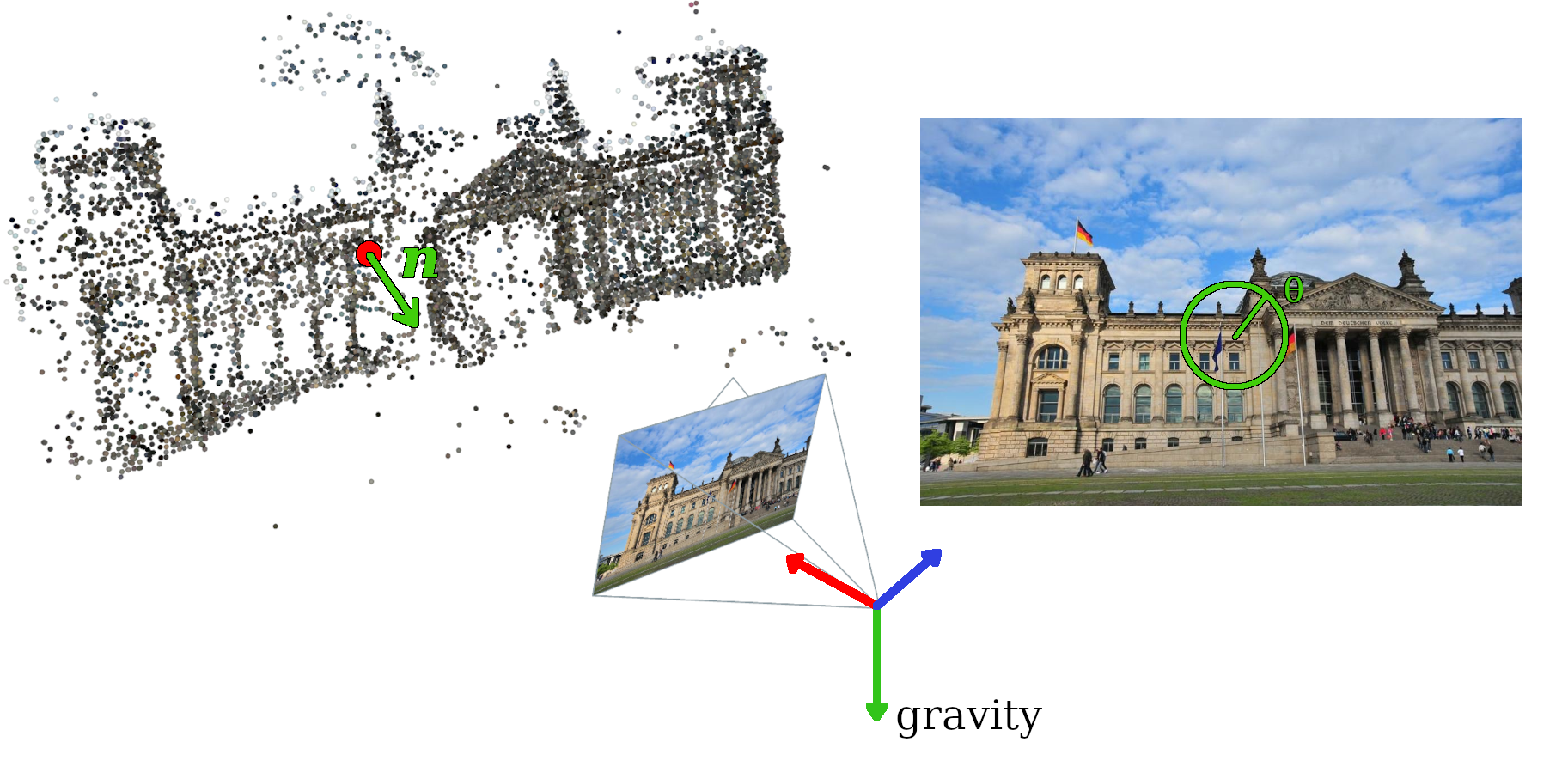
Problem geometry
We estimate absolute camera pose and focal length jointly by combining IMU gravity vectors with local geometric information from affine- or orientation-covariant feature descriptors.

Abstract

This work proposes two novel efficient solvers for joint absolute pose and focal length estimation, by combining IMU gravity vectors with local geometric information from feature descriptors. Using a known gravity direction reduces the camera rotation to a single unknown yaw angle, leaving five parameters in total: translation (3), yaw (1) and focal length (1). We show that affine-covariant features provide four additional constraints (enabling a single-correspondence solver), while orientation-covariant features provide one additional constraint (enabling a two-correspondence solver). Both formulations reduce to a quartic polynomial in the tangent half-angle of the yaw and admit analytical solutions, achieving faster and more accurate results than traditional methods.

Method

Problem setup. The camera rotation is factored as R = Ry Rxz, with Rxz known from the IMU gravity vector. This leaves five unknowns:

  • Translation t (3 parameters)
  • Yaw angle via tangent half-angle r = tan(θ/2) (1 parameter)
  • Focal length f (1 parameter)

Constraints. Point projections give 2 constraints. Affine-covariant descriptors add 4 new constraints (1 correspondence → 6 polynomial equations in 5 unknowns); orientation-covariant descriptors add 1 new constraint (2 correspondences → 6 polynomial equations in 5 unknowns).

Solvers

UP1PfAC — 1 affine correspondence: the system is linear in translation, allowing elimination; it reduces to a quartic in r with 4 solutions. Back-substitution recovers focal length and translation, and the unused constraint selects the optimal hypothesis.

UP2PfORI — 2 orientation-covariant features: a similar reduction using determinant constraints combines feature orientation invariants with point projections, again yielding a quartic in r with analytical solutions.
Results

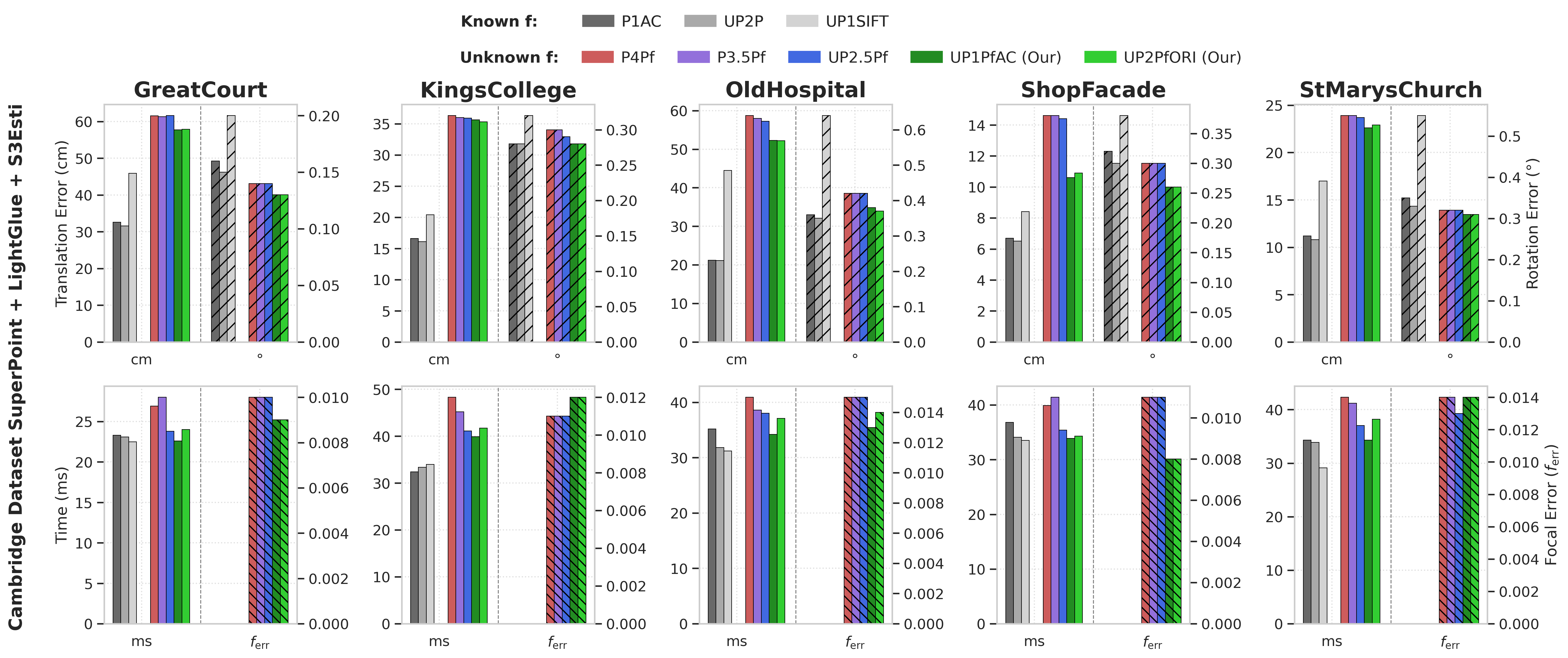
Cambridge Landmarks results
Cambridge Landmarks: pose error, focal length error and runtime using GC-RANSAC with SuperPoint+LightGlue.
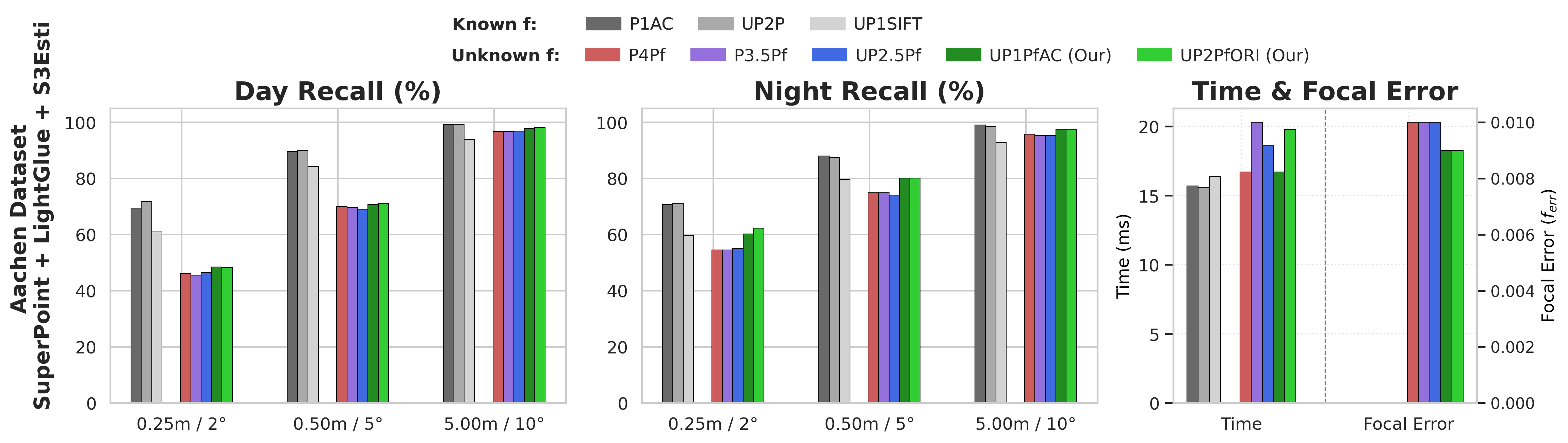
Aachen results
Aachen Day-Night: recall, focal length error and runtime.

BibTeX


@inproceedings{valtonenornhag2026gravity,
  title={Gravity-aware Partially Calibrated Absolute Pose Estimation from Affine- or Rotation-covariant Features},
  author={Valtonen~{\"O}rnhag, Marcus and Jaenal, Alberto and Adalbj{\"o}rnsson, Stefan},
  booktitle={European Conference on Computer Vision (ECCV)},
  year={2026},
}